Roman garlic and herb cheese
Source: Appendix Vergiliana, Moretum
Date: Late Republic to early Roman Empire, 1st century BCE to 1st century CE
Historical context
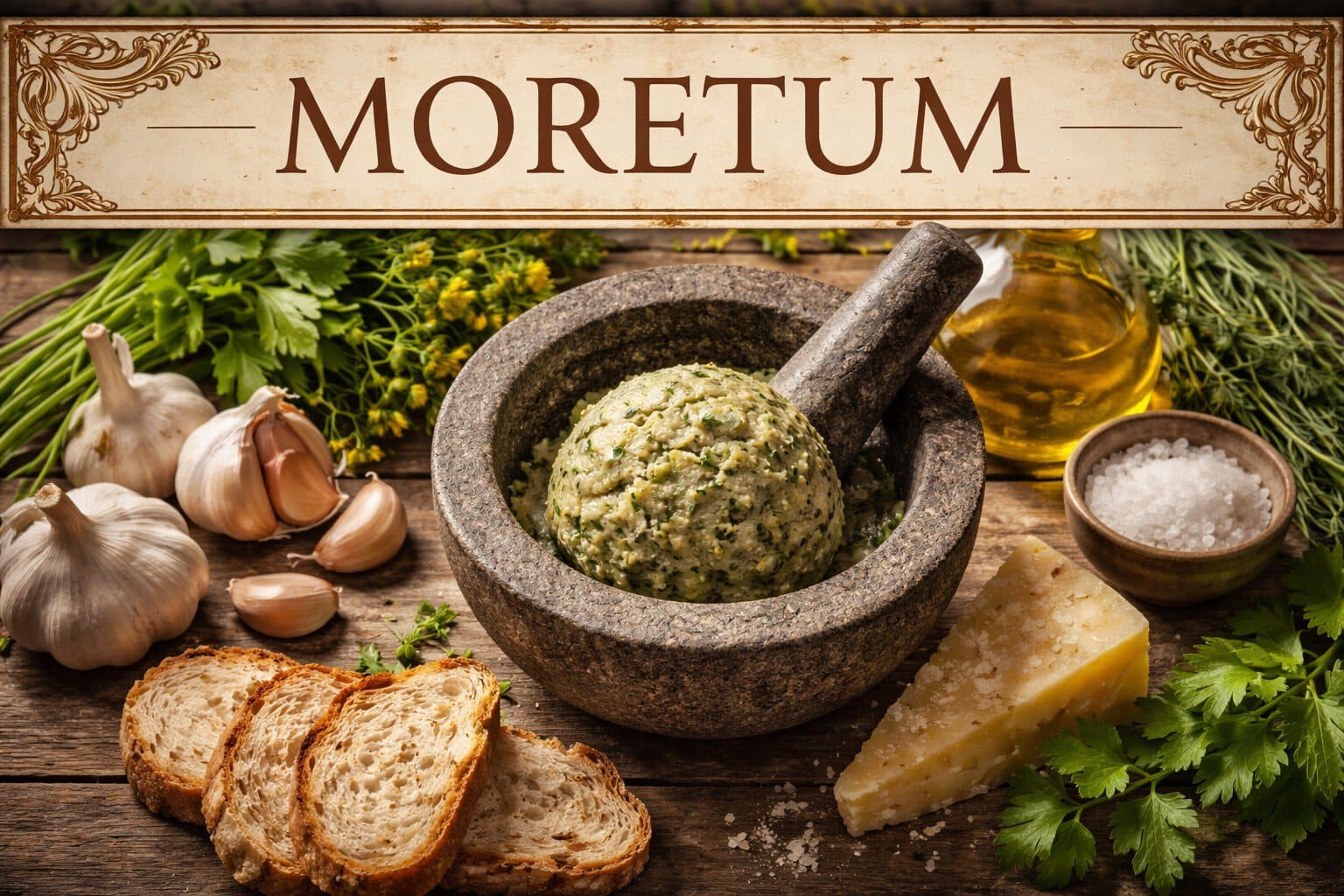
Moretum appears in a short Latin poem describing the morning routine of a small farmer named Simulus. The dish is prepared at dawn before fieldwork begins using ingredients gathered from the household garden and stored from earlier seasons. It is not elite cuisine but subsistence food intended to be filling portable and strong in flavor. Garlic bitter herbs salt and cheese reflect a working diet built for labor rather than leisure.
Preparation takes place entirely at home using a stone mortar and pestle. The process relies on pounding rather than chopping or stirring producing a dense paste that could be eaten with coarse bread. The poem emphasizes smell texture and effort underscoring how physical the act of cooking was in everyday Roman life.
Ingredients (as named in the poem)
- quattuor alia – four heads of garlic
- comas apii – celery leaves
- rutam – rue
- coriandra – coriander leaf
- salis micas – salt crystals
- durus caseus – hard aged cheese
- guttas oliui – olive oil added in drops
- exigui aceti – a small amount of vinegar
Method (following the poem’s order)
- Garlic celery leaves rue and coriander are gathered from the garden.
- The garlic is peeled and briefly rinsed.
- The garlic is placed into a stone mortar.
- Salt is added and the garlic is crushed.
- Hard aged cheese is added.
- The herbs are piled on top.
- The mixture is pounded and ground until the ingredients become a single unified paste.
- Olive oil is added slowly in drops and worked into the mixture.
- A small amount of vinegar is added and mixed through.
- The paste is gathered and shaped into a single ball.
Replicating Moretum today
To recreate this dish in a modern kitchen use a mortar and pestle if possible. Choose a firm aged sheep or goat cheese rather than a soft fresh cheese. Garlic should remain raw and assertive. Rue is historically accurate but very strong and should be used sparingly or omitted if unavailable. Celery leaf and coriander help preserve the original herbal profile.
Add olive oil gradually just enough to bind the paste and keep the vinegar minimal. The finished moretum should be thick pungent and rustic. Serve it with crusty bread or flatbread as a spread much as it would have been eaten in a Roman household before a day’s work.
Ingredients to note today
Rue is a strong-smelling, bitter herb called Ruta graveolens, used in antiquity far more often than it is today.
What it is
- A perennial shrub with blue-green leaves and small yellow flowers
- Native to the Mediterranean
- Grown in Roman household gardens
Why Romans used it
- Valued as both food and medicine
- Believed to aid digestion, ward off illness, and strengthen the body
- Common in rural and working-class cooking where bitterness was accepted and expected
In Moretum, rue provides a sharp, almost medicinal edge that balances the fat of cheese and oil and the heat of raw garlic.
Flavor profile
- Intensely bitter
- Resinous, herbal, slightly citrusy
- A little goes a very long way
Safety note (important)
Rue is not a casual culinary herb today.
- It can be irritating in large quantities
- It should only be used in very small amounts
- It is not recommended for pregnant individuals
Historically it was used sparingly, often more for its perceived medicinal qualities than for pleasure.
Using rue now
If you want strict historical accuracy, use one or two tiny fresh leaves only.
If you prefer a safer modern approach, many people substitute:
- A small amount of arugula
- Dandelion greens
- Or simply omit it and rely on celery leaf and coriander for bitterness
In Roman cooking, rue signaled strength, endurance, and seriousness. It was not there to be friendly.