Layered honey cheesecake
Source: Cato, De Agri Cultura 76, Placentam sic facito
Date: Mid 2nd century Rome BCE, commonly placed around 160 BCE
Historical context
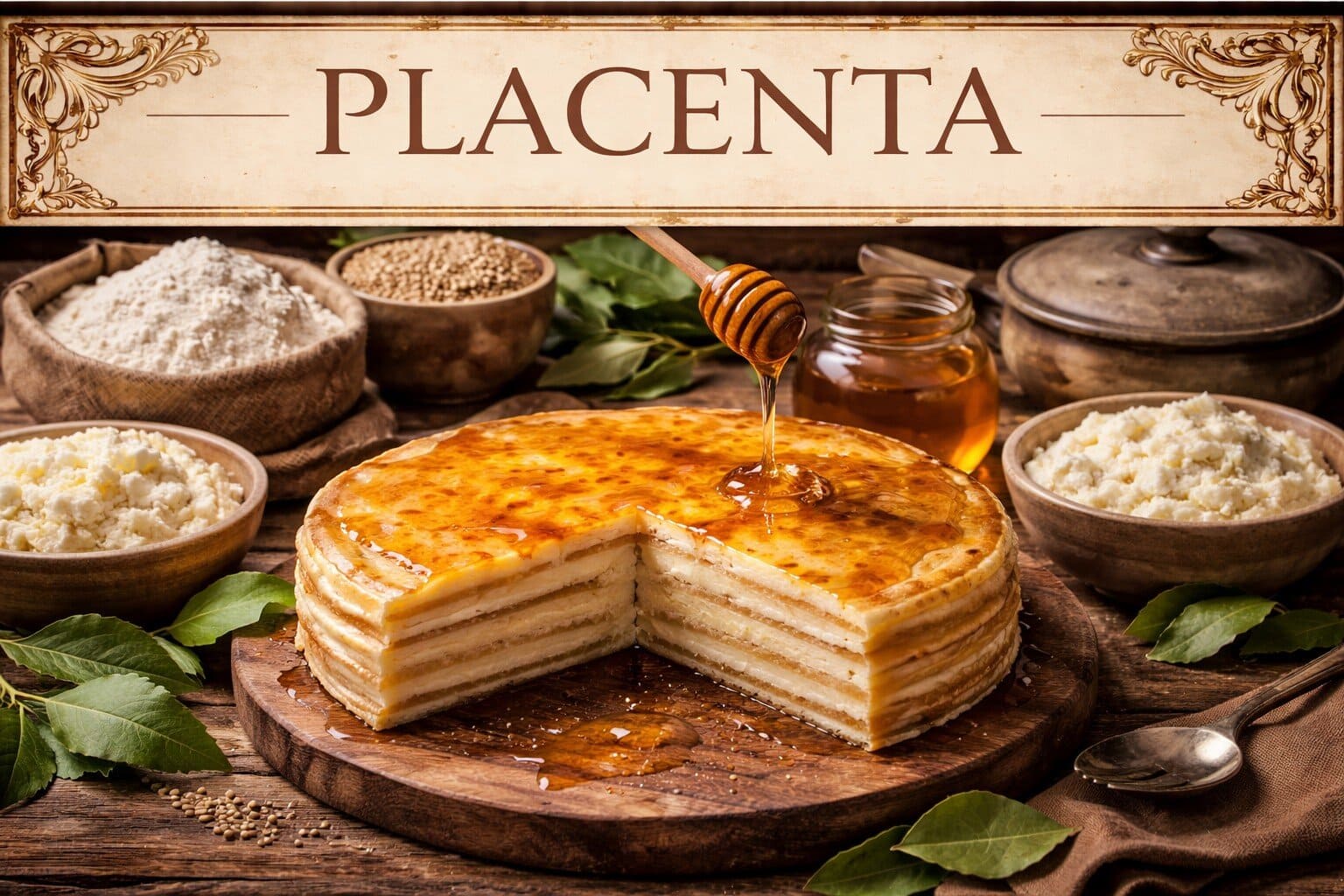
Placenta is a structured Roman baked sweet built in layers, closer to a layered cheesecake than a modern cake. In Cato it sits among practical farmhouse breads and cheeses, which places it in the world of working estates and household production rather than restaurant style cookery. It is labor intensive, ingredient heavy, and deliberately impressive, meaning it is best read as a special occasion food: something for hosting, ritual days, milestones, or any moment when a household wanted to display abundance and skill.
The defining technique is the use of tracta, thin sheets made from flour and groats, layered with a sweetened cheese filling. It is baked sub testu, under a heated clay or metal cover with coals on top, giving an even enclosed heat like a Dutch oven.
Ingredients named and specified by Cato
Crust and sheets
- farinae siligineae L. II – fine wheat flour for the crust base
- farinae L. IIII – flour for the tracta sheets
- alicae primae L. II – prime groats for the tracta sheets
- panno oleo uncto – oiled cloth for handling the sheets
- folia laurea uncta – bay leaves greased for the base board
Filling
- casei ovilli P. XIIII – sheep cheese, not sour, very fresh
- mellis boni P. IIII S – good honey, four and a half pounds
Baking and finishing
- focum calfacito, testum caldo – heat the hearth and the cover
- testo caldo operito, pruna insuper et circum operito – cover and bank with coals
- melle unguito – brush with honey at the end
Method in Cato’s order
Tracta preparation
- alicam in aquam infundito – soak the groats in water.
- ubi bene mollis erit, in mortarium purum indito, siccatoque bene – when soft, put into a clean mortar and dry well.
- deinde manibus depsito – knead by hand.
- farinae L. IIII paulatim addito – work flour in gradually.
- id utrumque tracta facito – make the tracta from the groats mixture and flour.
- in qualo, ubi arescant, conponito – set in a basket or sieve to dry.
- panno oleo uncto tangito, circumtergeto unguitoque – handle each sheet with an oiled cloth.
Crust and cheese preparation
8. farinae L. II conspargito condepsitoque, inde facito solum tenue – knead the crust dough and make a thin base.
9. casei ovilli ne acidum et bene recens in aquam indito, ibi macerato, aquam ter mutato – soak fresh sheep cheese in water, changing the water three times.
10. eximito siccatoque bene, in mortarium purum manibus condepsito conminuitoque – dry well, then break down in a clean mortar.
11. per cribrum farinarium facito transeat – push the cheese through a clean sieve.
12. mellis boni P. IIII S indito, id una bene conmisceto – add good honey and mix thoroughly.
Assembly
13. in tabula pura balteum ponito, folia laurea uncta supponito – set a clean board, lay down bay leaves.
14. tracta singula in totum solum primum ponito – lay a tracta sheet on the base first.
15. deinde de mortario tracta linito, tracta addito singulatim, item linito – spread filling, add a sheet, spread again, repeating.
16. donec omne caseum cum melle abusus eris – continue until all filling is used.
17. in summum tracta singula indito, postea solum contrahito – finish with tracta on top and draw the base up to enclose and tidy the edges.
Baking and finishing
18. focum calfacito bene et testum – heat hearth and cover well.
19. placentam inponito, testo caldo operito, pruna insuper et circum operito – cover and bank coals over and around.
20. videto ut bene et otiose percoquas, aperito bis aut ter – bake slowly, checking once or twice.
21. ubi cocta erit, eximito et melle unguito – remove and brush with honey.
Replicating Placenta today
To stay faithful while making it workable, keep the structure and technique, then scale it down.
Practical modern equivalents
- farinae siligineae: fine wheat flour
- alicae primae: wheat groats, semolina, or farina style wheat cereal
- casei ovilli: fresh sheep or goat cheese, or drained ricotta as the closest accessible stand in
- tracta: thin sheets, treated like simple pasta or phyllo thickness, brushed lightly with oil
- sub testu: bake covered in a Dutch oven or lidded casserole, or cover tightly with foil for the first half, then uncover to finish
A scaled modern build that keeps Cato’s logic
- Make thin tracta style sheets from flour plus semolina or soaked groats, roll thin, let them dry briefly, wipe with a lightly oiled cloth.
- Make a thin base dough from flour and water, roll it thin as your foundation.
- Mix fresh cheese with honey until smooth and spreadable.
- Layer sheet, filling, sheet, filling until the filling is used, top with a final sheet, then pull the base edges up neatly.
- Bake covered at moderate heat until set, uncover to color lightly, then brush with honey while warm.
The goal is not a fluffy cake. The goal is a dense layered honey cheese slab with clean strata, meant to be sliced.