Ancient Egyptian bread beer
Source: Archaeological evidence from breweries and tomb scenes, supported by textual references in administrative and medical papyri
Date: In use by the Old Kingdom and earlier, c. 2600 BCE, and continuing through all periods of ancient Egyptian history
Historical context
Ta-henket was not a luxury drink. It was a dietary staple in ancient Egypt, consumed daily by adults and children alike. Beer was safer than untreated water, nutritionally dense, and deeply embedded in labor systems, religion, and medicine. Workers were paid in beer rations, temples brewed it for offerings, and physicians prescribed it as a base for remedies.
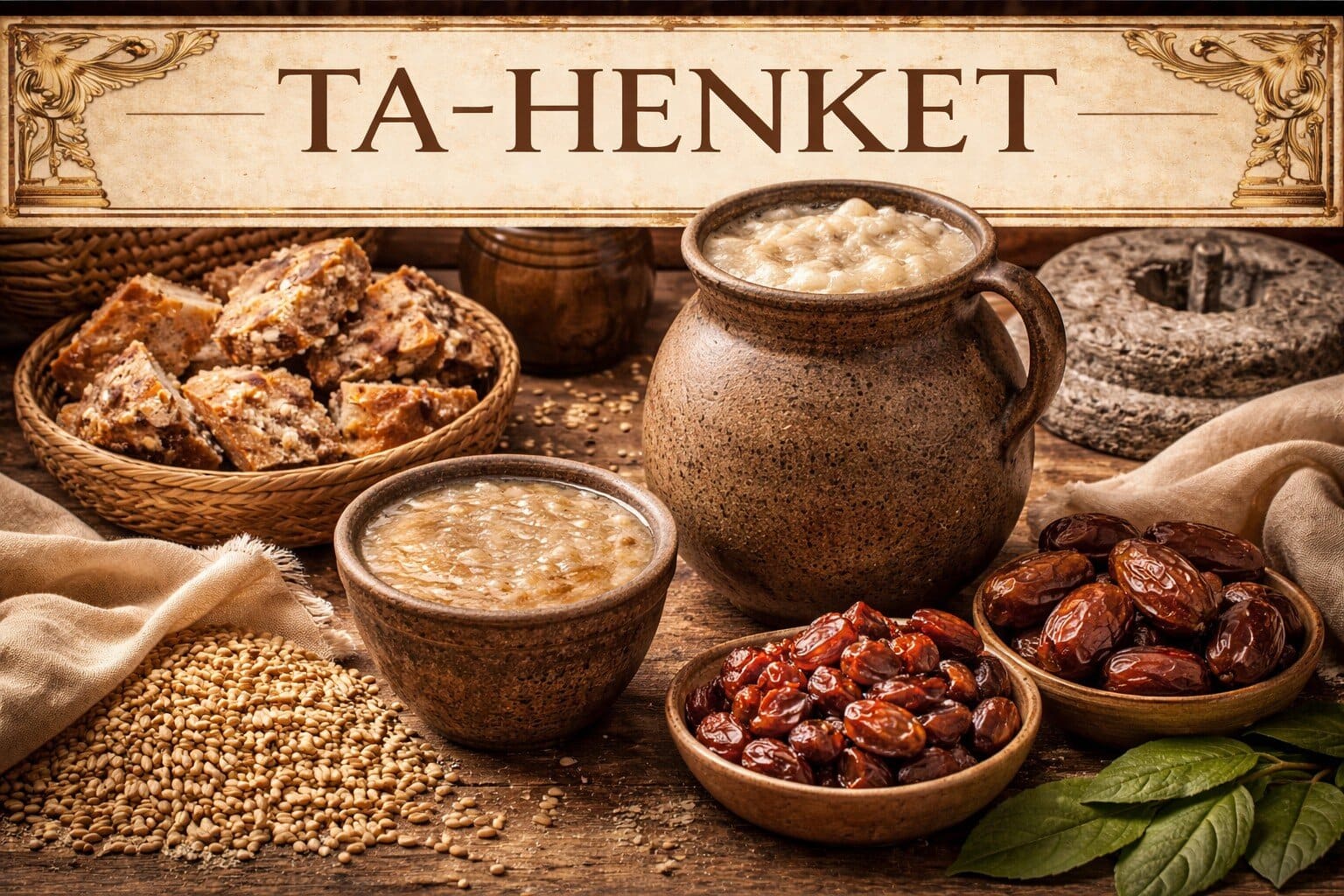
Unlike modern beer, ta-henket was thick, lightly fermented, and closer to a liquid bread. Brewing was primarily domestic, though large scale production existed in temple and state contexts. Tomb scenes show grinding, baking, mashing, and straining, while excavated breweries reveal large vats, ceramic strainers, and residue of fermented grain.
Ingredients (archaeologically and textually attested)
- Emmer wheat (primary grain)
- Barley (often combined with emmer)
- Water
- Date juice or mashed dates (frequently used as a fermentable sweetener)
- Wild yeast (from air, grain, and vessels)
No hops were used. Flavor came from grain, fermentation, and occasionally fruit.
Method (reconstructed from archaeological evidence)
- Emmer wheat and or barley are coarsely ground using stone querns.
- A portion of the grain is baked into lightly cooked bread loaves.
- Another portion remains raw or lightly malted.
- The baked bread is crumbled into a large vessel.
- Raw or malted grain is added.
- Warm water is poured over the mixture.
- Dates or date juice may be added to encourage fermentation.
- The mash is left to ferment naturally for one to three days.
- The liquid is strained through cloth or a perforated ceramic vessel.
- The beer is consumed fresh.
The result is cloudy, mildly alcoholic, and nourishing.
Who drank it
- Agricultural laborers
- Craftspeople and builders
- Priests and temple staff
- Children and adults
- The dead, as funerary offerings
Beer was not socially marginal. It was central.
Replicating Ta-henket today
To recreate ta-henket in a modern kitchen, focus on process rather than precision.
Modern equivalents
- Emmer wheat can be sourced from specialty grain suppliers, or substituted with farro
- Barley flour or crushed barley can be added
- Dates or date syrup replicate ancient sugars
- Natural fermentation can be encouraged with ambient yeast or a small amount of sourdough starter
Practical modern method
- Bake a dense, unsalted loaf from emmer or farro flour and water.
- Crumble the loaf into a heatproof vessel.
- Add additional crushed grain.
- Pour warm water over until soupy.
- Stir in mashed dates or date syrup.
- Cover loosely and allow to ferment at room temperature for 24 to 72 hours.
- Strain lightly, leaving sediment if desired.
- Drink fresh.
Expect a thick, tangy, bread like beverage, more porridge than pint.
Notes for modern audiences
- This is a low alcohol beverage, typically 2 to 4 percent
- It spoils quickly and was meant to be consumed fresh
- Texture and sediment are historically accurate
- Sweetness varies widely depending on dates and fermentation time